
For more than a century, copper has been the workhorse of connectivity. It’s cheap, easy to work with, and well understood by engineers and installers alike. From telephone lines to Ethernet to HDMI, copper has reliably carried our data signals. But every technology has limits, and for copper, that limit is now in sight.
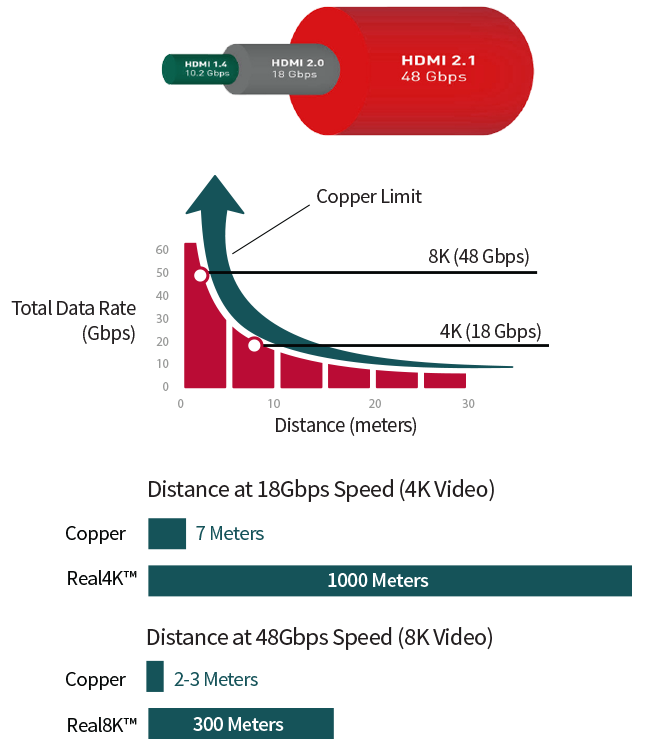
At today’s data rates—10 gigabits per second (Gbps) and beyond—copper cables are running into what we call the “copper cliff.”
What Is the Copper Cliff?
The copper cliff is the point where copper interconnects simply can’t keep up with the bandwidth demands of modern systems. At 10’s of gigabits per second, transmitting signals over any useful distance—especially through connectors and bulkheads—becomes a nightmare.
Some of the biggest challenges include:
- Signal integrity: High-speed electrical signals degrade quickly in copper, especially over distance.
- Group delay and skew: Not all parts of the signal travel at the same speed, which distorts data.
- Electromagnetic interference (EMI): Copper both radiates and picks up noise, creating headaches for both designers and installers.
These limitations aren’t theoretical, you see them in the real world. For example, HDMI copper cables quickly run out of steam when carrying 4K video. And for 8K video, where each channel is at 12 Gbps, the distance limit will be just 10–15 ft. Even “premium” copper cables can only manage short distances before requiring active electronics or compression tricks that reduce quality.
The Workarounds (and Why They Don’t Work)
To extend copper’s life, the industry has tried several strategies:
- Compressing data to reduce bandwidth. The result? Compromised quality or added latency.
- Adding shielding to protect against EMI. The tradeoff? Heavier, bulkier, and more expensive cables.
Neither approach is a sustainable path forward—especially in markets where reliability, size, weight, and performance all matter.
Fiber Optics: The Enabler Beyond 10 Gbps
Fiber optics solves these problems at the physical level. Light signals don’t suffer from the same interference and loss that plague electrical signals. With fiber, you can transmit ultra-high data rates over long distances, through connectors, and even through demanding environments without compromises.
And here’s the best part: once the fiber is in place, it’s future-proof. As data demands grow, you don’t have to replace the cable—just upgrade the optical subsystem. The fiber itself will support >>100 Gbps.
At Inneos, we’ve focused on making that transition from copper to fiber easier. Here’s how:
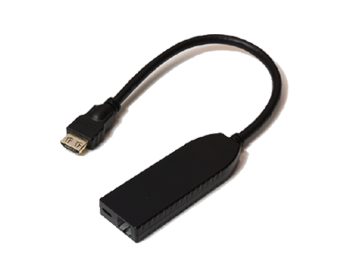
- Turnkey solutions: Optical adapters that let you swap copper for fiber without redesigning your system from scratch.
- Subsystem integration: Optical engines that drop into your designs for clean, high-performance connectivity.
- Core components: Our own high-reliability VCSEL and PIN devices for custom optical interconnects.


More Data, Less Fiber
One misconception is that moving to fiber means running bundles of fibers for every channel. With Inneos’ patented wavelength division multiplexing (WDM) technology, that’s not the case. We can send multiple data streams down a single strand of multimode fiber, dramatically simplifying design and installation.
This is especially powerful in applications that require fiber to pass through 360° rotary joints or ruggedized bulkhead connectors. Instead of wrestling with multiple fibers, you get high bandwidth with a single, robust fiber connection.
The Bottom Line
Copper has served us well, but physics has caught up with it. At data rates beyond 10 Gbps, it’s falling off the cliff. Fiber optics isn’t just an alternative—it’s the only practical path forward for high-bandwidth, low-latency, reliable connectivity.
The good news? With Inneos solutions, you don’t need to compromise or fear complexity. Whether you’re building next-gen video systems, aerospace platforms, medical devices, or automotive networks, fiber is ready to carry your data further, faster, and cleaner than copper ever could.