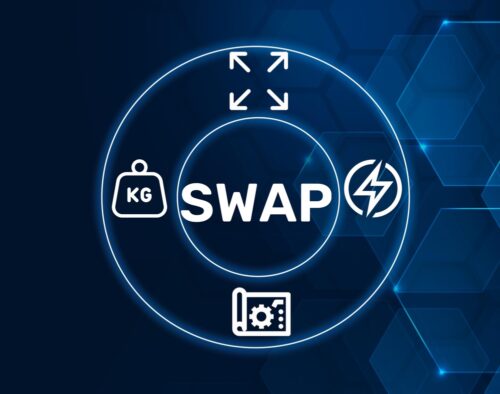
In modern electronic systems, performance is no longer defined by raw processing power alone. Whether the platform is an aircraft, a satellite, a medical imaging system, or a next-generation vehicle, engineers are constantly balancing a set of tightly coupled constraints known as SWaP: Size, Weight, and Power.
SWaP is more than a design guideline, it is a fundamental driver of what a system can do, how reliable it is, and where it can be deployed. As data rates climb and architectures become more distributed, managing SWaP has become one of the most important challenges in system design.
Breaking Down SWaP
Size
Size refers to the physical volume of components, cables, and subsystems. Smaller electronics allow more functionality to be packed into constrained spaces, enable tighter integration, and create room for redundancy or future upgrades.
Weight
Weight directly impacts fuel consumption, endurance, payload capacity, and handling—especially in airborne, space, and mobile platforms. Even small reductions at the component or cable level can translate into significant system-level benefits.
Power
Power includes not only the electrical power consumed, but also the thermal consequences of that consumption. Higher power means more heat, which drives the need for larger heat sinks, fans, or active cooling—further increasing size and weight.
Because these three factors are interconnected, improving one often improves the others. This is where connectivity technologies—particularly copper versus fiber—play a decisive role.
Copper Cables: The Traditional Tradeoff
Copper interconnects have long been the default choice for moving data and power between subsystems. They are familiar, widely available, and relatively inexpensive at low data rates and short distances.
However, as bandwidth requirements increase, copper begins to struggle from a SWaP perspective:
- Larger cable diameters are needed to maintain signal integrity at high data rates
- Heavier cable bundles add up quickly in distributed systems
- Higher power consumption is required to overcome attenuation and equalization losses
- Electromagnetic interference (EMI) requires shielding, further increasing size and weight
At multi-gigabit speeds, copper interconnects often drive the need for bulky connectors, thick shielding, and power-hungry signal conditioning—all of which directly degrade SWaP.
Fiber Optics: A Different Scaling Curve
Fiber optic interconnects scale very differently. Instead of fighting the physics of electrical loss and EMI, fiber leverages light to move data efficiently over long distances with minimal penalty.
From a SWaP perspective, fiber offers several inherent advantages:
- Smaller and lighter cables that replace thick copper bundles
- Lower power per bit at high data rates and longer reaches
- Immunity to EMI, eliminating heavy shielding requirements
- Consistent performance over temperature and distance
In many systems, replacing copper with fiber does not just reduce cable mass—it enables entirely new architectures, such as distributing processing closer to sensors or consolidating compute in a central location without performance loss.
Where Optoelectronics Make the Difference
Fiber alone does not solve the problem. The real SWaP gains come from the optoelectronic devices that convert electrical signals to optical signals and back again.
Modern optoelectronics—such as compact vertical-cavity surface-emitting lasers (VCSELs), photodiodes, and integrated optical engines—are designed to minimize size, weight, and power while supporting ever-higher data rates.
Well-designed optoelectronics can:
- Reduce total link power by eliminating aggressive electrical equalization
- Shrink connector and module footprints
- Enable higher channel density without thermal runaway
- Maintain performance across wide temperature ranges
At the platform level, these improvements compound. Lower power reduces cooling requirements. Smaller, lighter interconnects free up space and payload. Higher bandwidth enables better sensors, faster decision-making, and most importantly, improved mission effectiveness.
Platform-Level Impact: Why SWaP Really Matters
The true value of SWaP optimization is at the system level:
- Aircraft and UAVs gain longer range, higher payload capacity, or extended loiter time
- Satellites benefit from reduced launch mass, more flexible system design, and improved thermal margins
- Medical systems become easier to deploy, safer, and more flexible in hybrid operating rooms and clinical environments
- Vehicles and industrial platforms support more sensors and higher-resolution data without overwhelming power budgets
In each case, optical interconnects and advanced optoelectronics are not just incremental improvements—they are enablers of new capabilities.
SWaP as a Competitive Advantage
As systems continue to demand more data in smaller, lighter, and more power-constrained platforms, SWaP is no longer a secondary consideration. It is a key performance metric. By moving from copper to fiber—and by leveraging optoelectronics designed specifically for SWaP-constrained environments—engineers can unlock higher bandwidth, greater reliability, and better overall platform performance. In the end, SWaP is not just about fitting everything in. It’s about building systems that can go farther, do more, and last longer.